- Cantonese tones
- The six basic Cantonese tones
- How non-native speakers distinguish the six tones
- Cantonese tones vs. Mandarin tones
- Basic Cantonese vocabulary
- Greetings
- Polite Expressions
- Farewells
- Common questions
- Basic statements
- Constructing simple sentences
- 1. Self-introduction:
- 2. Asking questions:
- 3. Offering help:
- 4. Expressing gratitude:
- Frequently Asked Questions
- What are the six basic tones in Cantonese?
- How does the tonal system of Cantonese compare to Mandarin?
- What resources can help in learning Cantonese tones?
- Can you provide examples of basic Cantonese vocabulary?
- What steps can I take to improve my Cantonese pronunciation?
Cantonese is a prominent Chinese language alongside Mandarin, primarily spoken in southern China, especially in Guangdong province, Hong Kong, and Macau. While it uses the same written characters as Mandarin, its spoken form is notably different, offering a unique linguistic experience.
Cantonese features a unique tonal system that sets it apart from Mandarin. In this article, we’ll break down the fundamental tones and highlight their key differences from Mandarin. To make your learning journey easier, we’ll include straightforward examples along with essential vocabulary and commonly used phrases for everyday conversations. Dive in and start your Cantonese journey with us!
Cantonese tones
Similar to Mandarin, Cantonese is a tonal language, where the pitch and intonation of a word can change its meaning. Mandarin features four primary tones, along with a neutral tone, adding complexity to its pronunciation.
Curious about the tones of Cantonese? This vibrant language boasts a fascinating tone system featuring nine distinct tones. While six are considered the fundamental tones, the other three are known as “entering tones.” These tones conclude with a stop consonant such as “p,” “t,” or “k,” giving them a sharp, abrupt finish. This characteristic adds a rhythmic flair that sets Cantonese apart from other languages!
The entering tones—comprising the seventh, eighth, and ninth tones—mirror the pitch patterns of the first, third, and sixth tones. As a result, while there are technically nine distinct tones, we commonly simplify this to just six.
In Cantonese romanization systems like Jyutping, tone markings are represented by numbers ranging from one to six, which correspond to the six fundamental tones of the language. For example, the Chinese character “一” (meaning “one”) is associated with the seventh tone. However, in Jyutping, it is transcribed as “jat1” because its pitch pattern aligns with that of the first tone.
In this section, we’ll explore the first six tones using a five-line staff system. This notation method employs five lines to indicate various pitches, making it easier to visualize and memorize the tones. By understanding how these pitches are arranged, you’ll gain a clearer grasp of the tonal changes and sounds involved.
The six basic Cantonese tones
- **High Flat Tone:** This tone maintains a consistently high pitch, resembling the first tone in Mandarin. Words pronounced in this tone sound as if they are held on a steady note. For example, “知” (zi1), meaning “know.”
- **High-Rising Tone:** This tone begins at a medium pitch and ascends to a high pitch, resembling the second tone in Mandarin. It conveys a questioning intonation or a subtle upward inflection. For instance, the word “纸” (zi2) means paper.
- Mid-flat tone: This tone maintains a consistent middle pitch, producing a flat sound that is lower than the first tone. Example: “只” (zi3, meaning “only”).
- **Low Falling Tone**: This tone drops from a medium to a low pitch, resembling Mandarin’s fourth tone but with a softer quality. Example: “字” (zi4, meaning “word”).
- **Low Rising Tone:** This tone begins at a low pitch and rises to a medium pitch, characterized by a gentle upward inflection. Example: “治” (zi5, meaning “treat”).
- **Low Flat Tone:** This tone maintains a consistently low pitch, producing a flat sound lower than the third tone. Example: “自” (zi6, meaning “oneself”).

How non-native speakers distinguish the six tones
Visualizing the tones with a five-line staff can help you understand their pitch patterns.
The five-line staff system for Cantonese tones offers a clear visual representation of pitch variations. To deepen your understanding of this system, check out this informative video:

Five-line staff system
Similar to learning Mandarin, a great method for mastering Cantonese tones is to create a tone chart. For a visual guide, check out the video below for inspiration. Additionally, consider using flashcards that feature tone markings to quiz yourself and reinforce your learning.
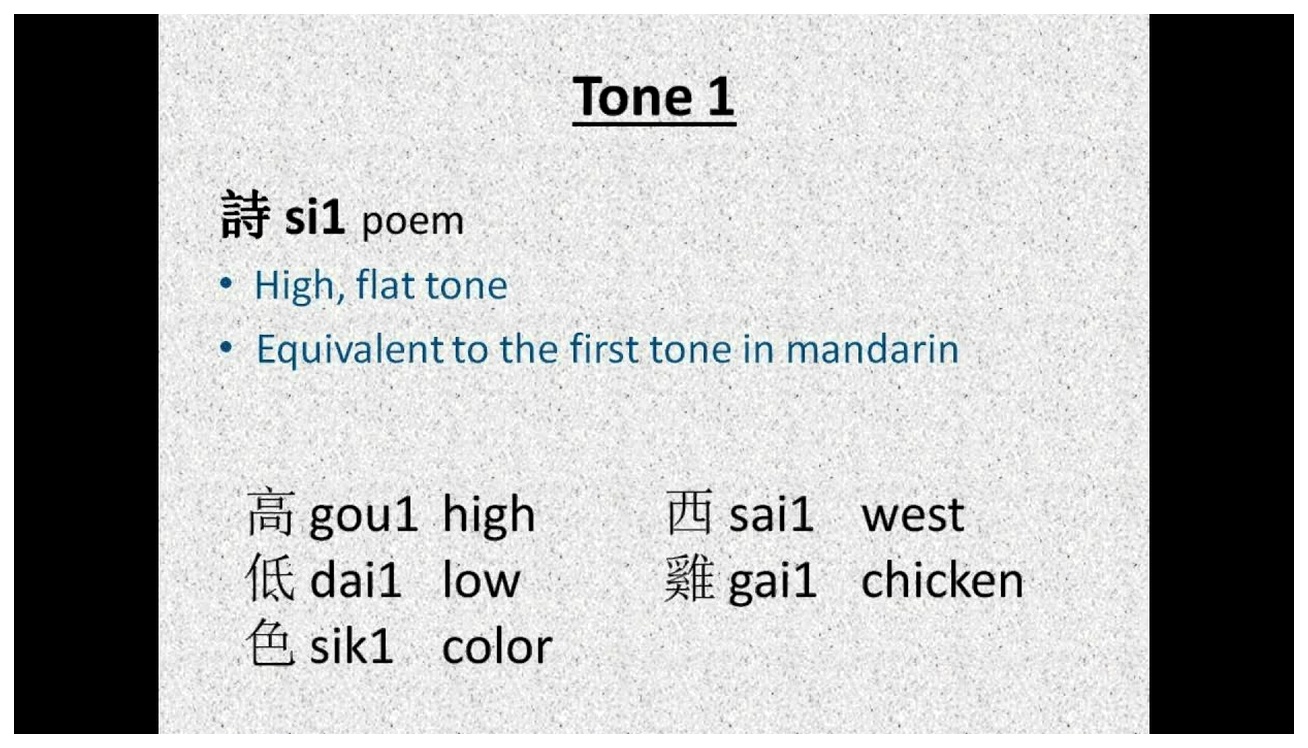
If you’re already familiar with Mandarin tones, this can serve as a useful reference point.
Cantonese tones vs. Mandarin tones
Mandarin’s first and second tones are similar to Cantonese’s first and second tones, respectively.
Cantonese features a unique tonal system where its fourth tone resembles the falling segment of Mandarin’s third tone, while the fifth tone mirrors the rising component of that same tone. This comparison highlights the distinct yet interconnected nature of tonal pronunciation between the two languages.
Let’s take a closer look at the third tone in Mandarin using the word “Mǎ” (马), which translates to “horse.” This tone starts with a downward pitch before rising again. To dive deeper into the nuances of Mandarin tones, click here for more information.
Basic Cantonese vocabulary
To incorporate Cantonese into your daily life, it’s essential to familiarize yourself with some key vocabulary. Below are some useful words and phrases to kick off your learning journey:
Greetings
- 你好 (nei5 hou2) – Hello
- 早晨 (zou2 san4) – Good morning
- 晚安 (maan5 on1) – Good night
Polite Expressions
- 谢谢 (do1 ze6) – Thank you (used when someone gives you something)
- 唔该 (m4 goi1) – Thank you (used when someone does something for you)
- 请 (cing2) – Please
- 对不起 (deoi3 m4 zyu6) – Sorry
Farewells
- 再见 (zoi3 gin3) – Goodbye
- 拜拜 (baai1 baai3) – Bye-bye
Common questions
- 你叫什么名字? (nei5 giu3 me1 ming4 zi6?) – What’s your name?
- 你几岁了? (nei5 gei2 seoi3 laa3?) – How old are you?
Basic statements
- 我是美国人。 (ngo5 si6 mei5 gwok3 jan4) – I’m American
- 我住在香港。 (ngo5 zyu6 zoi6 hoeng1 gong2) – I live in Hong Kong
Constructing simple sentences
Once you have some basic vocabulary, you can start constructing simple sentences. Here are a few examples to practice:
1. Self-introduction:
- 你好,我是John。(nei5 hou2, ngo5 si6 John.) – Hello, I’m John
- 我来自美国。(ngo5 loi4 zi6 mei5 gwok3.) – I’m from the United States
2. Asking questions:
- 你好吗? (nei5 hou2 maa3?) – How are you?
- 这是哪里? (ze3 si6 naa1 lei4?) – Where is this?
3. Offering help:
- 需要帮忙吗? (seoi1 jiu3 bong1 mong4 maa3?) – Do you need help?
- 让我来。(joeng6 ngo5 lai4.) – Let me help
4. Expressing gratitude:
- 多谢你。 (do1 ze6 nei5.) – Thank you
- 谢谢你的帮助。 (do1 ze6 nei5 dik1 bong1 zyu6.) – Thanks for your help
What’s the next step in your Cantonese learning journey? To enhance your tone pronunciation, try practicing with native speakers. Language exchange platforms and apps are excellent resources for finding a conversation partner. Alternatively, hiring a Cantonese tutor can offer personalized support; they will help you identify and correct tone errors while providing valuable feedback. For tips on selecting the right tutor, check out the LingualNeeds guidelines.
To elevate your language skills, consider incorporating listening exercises from Chinese podcasts into your routine. These resources provide authentic exposure to the language. Additionally, participating in online classes allows you to hear native speakers using tones in real-life contexts. You can further enhance your learning by practicing pronunciation and intonation through imitation during these sessions.
Keep in mind that Cantonese has just six fundamental tones, many of which resemble the tones found in Mandarin. Practicing Cantonese tones in tandem with Mandarin can be a great strategy. This approach not only strengthens your grasp of Cantonese tones but also reinforces your memory of both languages.
Frequently Asked Questions
What are the six basic tones in Cantonese?
The six basic tones in Cantonese are High Flat Tone, High-Rising Tone, Mid-flat Tone, Low Falling Tone, Low Rising Tone, and Low Flat Tone.
How does the tonal system of Cantonese compare to Mandarin?
Cantonese features a unique tonal system with nine distinct tones, while Mandarin has four primary tones. Some tones in Cantonese resemble those in Mandarin, such as the first and second tones.
What resources can help in learning Cantonese tones?
Resources for learning Cantonese tones include tone charts, flashcards with tone markings, and videos that visualize the five-line staff system.
Can you provide examples of basic Cantonese vocabulary?
Sure! Examples of basic Cantonese vocabulary include: 你好 (nei5 hou2) – Hello, 谢谢 (do1 ze6) – Thank you, and 再见 (zoi3 gin3) – Goodbye.
What steps can I take to improve my Cantonese pronunciation?
To improve your Cantonese pronunciation, practice with native speakers, use language exchange platforms, consider hiring a tutor, and listen to Chinese podcasts for authentic exposure.