- Which colleges do top CEOs go to?
- What degree do you need to be a CEO?
- What percentage of CEOs have a master’s or doctorate degree?
- Do you need an MBA to be a CEO?
- What did most CEOs study?
- What percentage of CEOs are female?
- What percentage of CEOs have studied abroad?
- Conclusion
- Methodology
- Frequently Asked Questions
- What are the top schools for aspiring CEOs?
- What percentage of CEOs hold advanced degrees?
- Do you need an MBA to become a CEO?
- What fields do most CEOs study?
- What percentage of CEOs are women?
Are you inspired by iconic leaders like Steve Jobs or Sundar Pichai, or do you aspire to carve out your own unique path as a CEO? Whatever your ambition, knowing how to begin your journey is crucial. Luckily, LingualNeeds has done the legwork for you, compiling comprehensive research on the top schools worldwide that can help you become a successful CEO.
LingualNeeds conducted an insightful analysis of 1,000 CEOs from Forbes’ list of the largest global companies to create a comprehensive ranking and index score for the best schools producing top executives. Here are the five leading colleges for aspiring CEOs, as determined by their findings:
- Harvard University (United States)
- Ecole Centrale de Paris (France)
- University of Pennsylvania (United States)
- Stanford University (United States)
- University of California (United States)
Our analysis reveals the key traits that successful CEOs tend to have in common, including their educational backgrounds and the specific subjects they studied. Here are the important global insights we’ve uncovered in this research:
- Top CEOs often study economics, business administration, and engineering. Notably, 34.6% hold a master’s or doctorate, 22.3% possess an MBA, 16.4% have studied abroad, and 4.7% are women.
Which colleges do top CEOs go to?
Choosing the right university can be a challenging task, especially for aspiring CEOs. Fortunately, several institutions consistently rise to the top, offering unique programs and resources designed to cultivate future leaders.
LingualNeeds has evaluated the best universities for aspiring CEOs by merging the percentage of alumni who have become CEOs with each institution's World University Ranking. The result? The top three universities that stand out for fostering future leaders are:
-
-
- Harvard University (United States)
- Ecole Centrale de Paris (France)
- University of Pennsylvania (United States)
-
Notably, two of the top three universities in the world are situated in the United States. When expanding the list to the top 30 institutions, an impressive 22 are also American. While countries like France and Japan do boast some of the highest-ranking universities for future CEOs, the United States remains home to the majority of the world’s premier educational institutions.



Learn a language with personalised 1-on-1 classes with our expert tutors from all over the world
French lessons online
Spanish lessons online
What degree do you need to be a CEO?
The journey to becoming a top-tier CEO isn't a one-size-fits-all route. In fact, the most successful CEOs often come from a wide array of educational backgrounds, having earned degrees in various fields and explored a multitude of subjects throughout their careers.
For instance, Jeff Bezos graduated from Princeton University with a degree in electrical engineering and computer science. In contrast, Bill Gates attended Harvard College, where he explored pre-law, mathematics, and computer science, but ultimately left before completing his degree.
Climbing the corporate ladder doesn’t have a one-size-fits-all approach, so take the time to delve into the insights and trends revealed in this study. By doing so, you can identify a career path that aligns with your unique interests and skill set.
What percentage of CEOs have a master’s or doctorate degree?
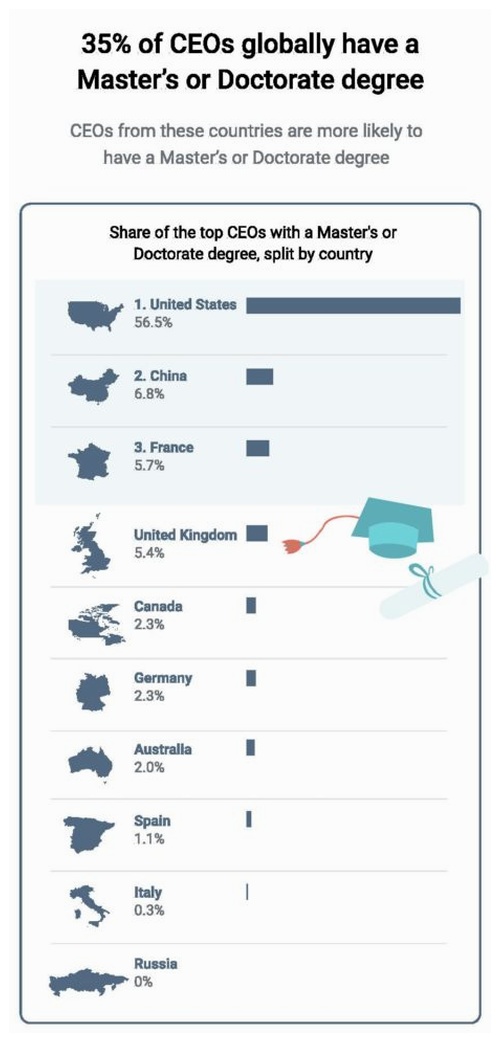
Among the 1,000 CEOs featured on Forbes' list of the largest global companies, 34.6% hold advanced degrees, such as a master's or doctorate. Notably, the majority of these leaders hail from the United States, constituting 56.5% of the total, while 6.8% are from China.
Conversely, the representation of CEOs from other countries with advanced degrees is relatively low. For instance, only 5.7% of CEOs in France, 5.4% in the UK, and 2.6% each in India and Switzerland hold such qualifications. Meanwhile, Canada and Germany show even lower figures at 2.3%.
A significant number of active CEOs have prioritized advanced education, exemplified by leaders such as Kim Ki Nam of Samsung Electronics, who holds a Ph.D. in electrical engineering from the University of California, and Ramon Laguarta of PepsiCo, who earned a master’s in international management from Arizona State University. This trend highlights the value these executives place on higher learning in their professional journeys.
Interestingly, a significant number of leading executives opted for just a bachelor’s degree, such as Hans Vestberg from Verizon Communications and Andrew Witty from UnitedHealth Group. In fact, some influential figures, like Kenichiro Yoshida of Sony and Frederick W. Smith of FedEx, achieved remarkable success without any formal degree at all.
Do you need an MBA to be a CEO?
The simple answer is "no," you don't need an MBA to become a CEO. However, it's interesting to note that 22.3% of the world's leading CEOs have chosen to pursue this degree. The United States leads the pack with a remarkable 68.7% of its top CEOs holding MBAs, while China and France each follow at a distant 5.3%.
Interestingly, none of the other countries on the list surpass a 5% rate of MBA holders: the UK stands at 4.8%, while Switzerland, Canada, Australia, and Spain each have a mere 1.8%. This highlights that even prominent leaders like Tim Cook of Apple, Andy Jassy of Amazon, and Satya Nadella of Microsoft may have pursued an MBA, but it's clear that such a degree is not a prerequisite for success.

What did most CEOs study?
The elite group of CEOs predominantly gravitate towards three key fields of study: economics (11.6%), business administration (7.6%), and engineering (5.3%). For instance, Warren Buffett, the renowned CEO of Berkshire Hathaway, earned his degrees in business administration from the University of Nebraska and economics from Columbia University. Similarly, Jean-Laurent Bonnafé, the CEO of BNP Paribas, pursued engineering at École Polytechnique and École des Mines.
While many CEOs follow traditional paths, some have ventured into less conventional fields of study. For example, 4.1% of top CEOs hold law degrees, including Brian Moynihan, the CEO of Bank of America, who graduated from the University of Notre Dame Law School. Additionally, 3.3% of these leaders majored in finance, such as Daniel Zhang of Alibaba Group, who earned his degree from Shanghai University of Finance and Economics.
Interestingly, some CEOs have backgrounds in less conventional fields, with only 0.2% of leaders having majored in subjects like theology or zoology. For example, Marco Alverà, the CEO of Snam, studied philosophy and economics at the London School of Economics, showcasing the diverse academic paths that can lead to success in the corporate world.
What percentage of CEOs are female?
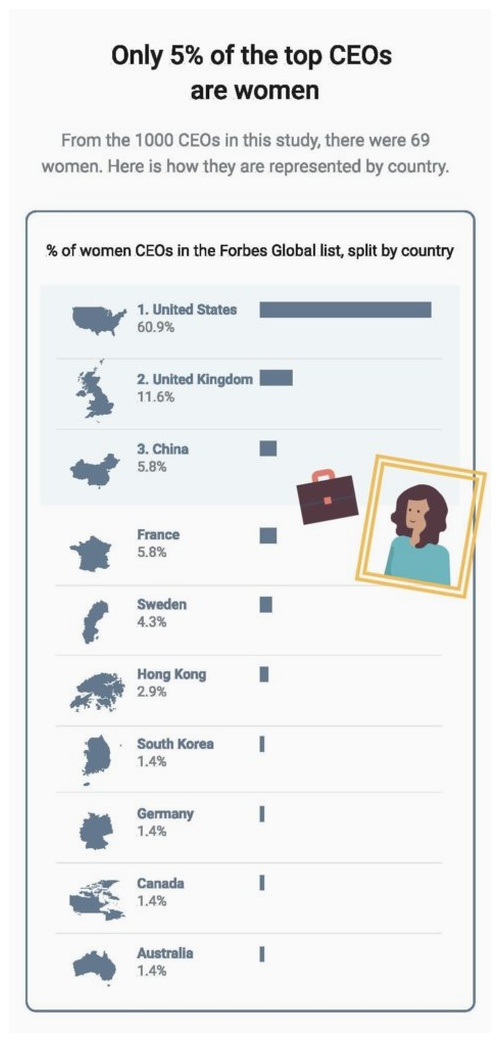
A recent analysis of 1,000 major global companies by Forbes reveals a striking statistic: only 4.7% of top CEOs are women. This finding is consistent with CNBC’s figures, which show that women currently hold just 4.6% of positions in Global 500 companies. Interestingly, this percentage marks the highest representation of female CEOs in the Global 500 to date.
The research highlights that a significant majority of female entrepreneurs—60.9%—are based in the United States. Despite this, women hold a mere 8.2% of CEO positions in Fortune 500 companies across the country. Following the U.S., the United Kingdom ranks second with 11.6% representation, while China comes in third at 5.8%. Additionally, only nine other countries are represented in the ranks of influential businesswomen: France, Sweden, Hong Kong, South Korea, Germany, Canada, Australia, Norway, and Poland.
While the number of women CEOs has risen, the statistics reveal that this role is still predominantly held by men.
Learn a language online with our free learning materials.
Learn English online
Learn French online
What percentage of CEOs have studied abroad?
Among the 1,000 top CEOs from Forbes' list of the largest global companies, only 16.4% have pursued their studies abroad. Consistent with earlier research, the United States leads the way, boasting 22.2% of these CEOs with international educational experiences.
Trailing closely behind was China, accounting for 10.8% of foreign-educated CEOs, followed by the UK at 9.0%. India and South Korea each contributed 6.6%, while Germany represented 6.0%. Other countries had smaller shares, with France at 4.9%, and Canada, Australia, and Spain each at 3.0%, along with Italy also at 3.0%.
While studying abroad may not be a common trait among the world’s top CEOs, it certainly offers a wealth of advantages that draw students from all corners of the globe. Many seek the enriching experience of immersing themselves in new cultures while honing their language skills, whether in English or the local tongue. With LingualNeeds, you can elevate your language abilities through online lessons in Spanish, Japanese, and more. Additionally, you have the option to enroll in specialized courses, like accent reduction, to further refine your communication skills.

Conclusion
This study aimed to pinpoint the top schools for aspiring CEOs. The findings highlight three standout institutions: Harvard Business School, École Centrale de Paris, and the University of Pennsylvania, which are recognized for shaping future leaders in the business world.
Additionally, the research identified key traits that are commonly found among successful entrepreneurs in today's business landscape. Notably, a higher percentage of top CEOs possess a master's or doctorate degree rather than an MBA.
The leading subjects among this elite group included economics, business administration, and engineering, with only a small fraction choosing to study abroad. Additionally, the landscape of corporate leadership remains male-dominated, as few women hold CEO positions in the world's largest companies.
While this analysis reveals various patterns and trends, it's important to recognize that each CEO's journey is distinct and shaped by individual experiences. With this in mind, explore the options available to you and choose the path that aligns best with your ambitions to join the ranks of the world's top CEOs.
Methodology
LingualNeeds conducted an insightful analysis of CEO alma maters from the Forbes Global list of the world's largest companies to identify which universities are the breeding grounds for top global CEOs. By examining a diverse group of 1,000 CEOs, they compared various factors including the universities attended, degree types, fields of study, industry sectors, and earnings potential. This comprehensive study sheds light on the educational backgrounds that shape today's business leaders.
LingualNeeds compiled their alma mater list by collecting biographical data on top CEOs from various sources, including company resources, direct outreach to colleges and universities, and thorough online research.
The 'CEO Index Score' is calculated by analyzing the percentage of graduates who become CEOs from each institution, along with their scores in the World University Rankings. This dual approach provides a comprehensive view of a school's effectiveness in fostering future business leaders.
Forbes compiles its list of top CEOs by evaluating the world's largest public companies based on four key metrics: assets, market value, sales, and profits. Each of these factors is given equal importance, providing a comprehensive overview of corporate performance.
Frequently Asked Questions
What are the top schools for aspiring CEOs?
The top schools for aspiring CEOs are Harvard University, Ecole Centrale de Paris, and the University of Pennsylvania.
What percentage of CEOs hold advanced degrees?
34.6% of CEOs hold advanced degrees, such as a master's or doctorate.
Do you need an MBA to become a CEO?
No, you do not need an MBA to become a CEO, although 22.3% of CEOs have one.
What fields do most CEOs study?
Most CEOs study economics, business administration, and engineering.
What percentage of CEOs are women?
Only 4.7% of top CEOs are women.