- When to Use Which or That: The Most Common Cases
- Restrictive & nonrestrictive relative clauses
- The difference between thatand which
- That is used for a restrictive clause
- “Which” is used for a nonrestrictive clause
- When to use whichor thatin examples
- What about exceptions?
- Frequently Asked Questions
- What is the main difference between ‘which’ and ‘that’?
- What is a restrictive clause?
- What is a nonrestrictive clause?
- Can ‘which’ and ‘that’ be used interchangeably in British English?
- What punctuation rules apply when using ‘which’ and ‘that’ in American English?
When to Use Which or That: The Most Common Cases
When should you use “which” or “that”? These words are part of our everyday speech, but their usage isn’t as straightforward as it appears. In contemporary English, “that” and “which” are often seen as interchangeable, making it increasingly challenging to grasp the distinction between them.
Misusing “which” and “that” is one of the most frequent grammar pitfalls. Even after years of studying English, you might still feel unsure about when to use each term. To master their usage, it’s essential to grasp the distinction between restrictive and nonrestrictive clauses. This understanding will clarify how to use “which” and “that” correctly in your sentences.
Restrictive & nonrestrictive relative clauses
There are two types of the relative clause ‒ restrictive and nonrestrictive. Let’s have a closer look at each of them:
- A restrictive clause, or defining clause, limits the meaning of the noun it modifies. Omitting a restrictive clause alters the sentence’s meaning.
- A nonrestrictive clause (or non-defining/nonessential clause) adds extra information about a noun and can be omitted without altering the sentence’s meaning.
Understanding when to use “which” or “that” can be tricky with just basic definitions. To help you master this distinction, we’ve provided clear explanations and examples that will guide you through the nuances of these terms.

The difference between that and which
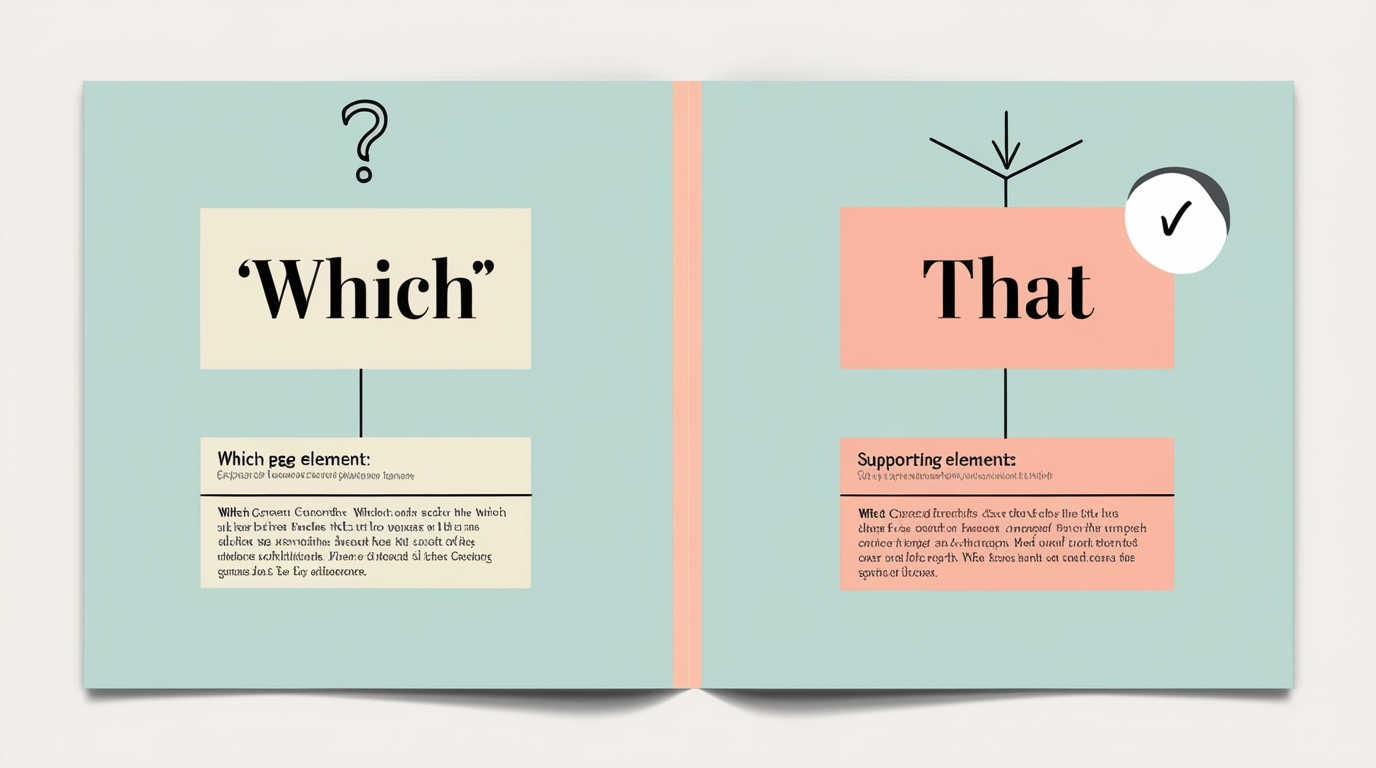
That is used for a restrictive clause
A restrictive clause provides essential information about the noun it follows, helping to identify or narrow down its meaning. Removing this clause from a sentence alters its overall message. For instance:
Baby food products that contain soybeans are the best ones.
Note that there should be no commas before and after the clause.
This sentence features a restrictive clause, “that contain soybeans,” highlighting the variety of baby food options available. Removing this clause alters the sentence’s meaning to suggest that all baby food products are the best, rather than specifying those that contain soybeans. In essence, this clause provides crucial details that shape the overall message.
“Which” is used for a nonrestrictive clause
In contrast, a nonrestrictive relative clause offers extra, non-essential information about a noun. For instance, consider the following example alongside the one before it:
Soybean baby food products, which are Tom’s favourite, are the best for his diet.
Note that commas separate a nonrestrictive clause.
Do you know when to use “which” versus “that”? While both introduce clauses that add information, they serve different purposes. A restrictive clause, introduced by “that,” is essential for understanding the sentence’s meaning, while a nonrestrictive clause, introduced by “which,” adds extra details that can be omitted without changing the overall message. For example, in the sentence “Soybean baby food products are the best for his diet,” you could remove the nonrestrictive clause without altering its core meaning.
When to use which or that in examples
Using which instead of that or vice versa can change the meaning of your words. Let’s consider the following examples:
- Our office that has three meeting rooms is located in New York.
We have several offices, but the office with three meeting rooms is located in New York.
- Our office, which has three meeting rooms, is located in New York.
- We have only one office, and it’s located in New York.
- Can I get the pen that I gave you this morning?
- Cheesecake, which is my favourite treat, goes well with strawberry jam.
- The luggage that is over 25 pounds will not be permitted.
- My bedroom, which is on the third floor, is very light.
What about exceptions?
You’ve discovered that a restrictive clause is typically introduced by “that.” Interestingly, in British English, you can replace “that” with “which” without changing the meaning at all.
- Who ate the chocolates that I bought yesterday?
- Who ate the chocolates which I bought yesterday?
The first example is the correct choice, but many people mistakenly believe the second sentence is acceptable too. In British English, both “which” and “that” can be used interchangeably for restrictive clauses without altering the meaning, especially in casual conversations. However, it’s important to remember that in American English, “which” is reserved solely for nonrestrictive clauses.
For clarity and safety, we suggest adhering to American punctuation rules. This approach simplifies your decision-making process regarding comma usage: in American English, commas should precede “which” but not “that.” It’s as straightforward as A, B, C!
Frequently Asked Questions
What is the main difference between ‘which’ and ‘that’?
‘That’ is used for restrictive clauses, while ‘which’ is used for nonrestrictive clauses.
What is a restrictive clause?
A restrictive clause limits the meaning of the noun it modifies and is essential for understanding the sentence.
What is a nonrestrictive clause?
A nonrestrictive clause adds extra information about a noun and can be omitted without changing the overall meaning of the sentence.
Can ‘which’ and ‘that’ be used interchangeably in British English?
Yes, in British English, ‘which’ can sometimes replace ‘that’ in restrictive clauses without changing the meaning.
What punctuation rules apply when using ‘which’ and ‘that’ in American English?
In American English, commas should precede ‘which’ but not ‘that’.