- How to use the in, on, and at prepositions
- In, on & at as prepositions of place
- In, on & at as prepositions of time
- Preposition switching in American and British English
- On and at
- In and for
- In and at
- Common mistakes with prepositions in, on, or at
- Mixing up time and place usage:
- Using “in” instead of “on” for days and dates:
- Using “in” or “on” instead of “at” for specific addresses or locations:
- With some idiomatic expressions:
- Using “at” with pages (including web pages):
- Understanding the Difference: “In the End” vs. “At the End” in Time and Outcome Contexts
- When you don’t have to use the in, on, and at prepositions at all
- Before general time expressions:
- Before specific verbs or phrases that don’t require prepositions:
- Before “next” or “last”:
- Final thoughts on the in, on, and at prepositions
- Frequently Asked Questions
- What are the main prepositions of time and place in English?
- When should I use ‘at’ as a preposition?
- How is ‘on’ used differently from ‘in’ and ‘at’?
- What are common mistakes learners make with these prepositions?
- How do American and British English differ in the use of these prepositions?
Mastering the use of prepositions of time and place can be challenging, whether you’re learning English online or in a classroom. The distinctions between “in,” “on,” and “at” can be particularly confusing, especially when trying to determine when to use each one. Understanding these nuances is key to improving your English proficiency.
Fortunately, there are clear scenarios where the prepositions “in,” “on,” and “at” are used distinctly. We’re excited to share these insights with you! The following guidelines will ensure you choose the right preposition for both place and time every time.
How to use the in, on, and at prepositions
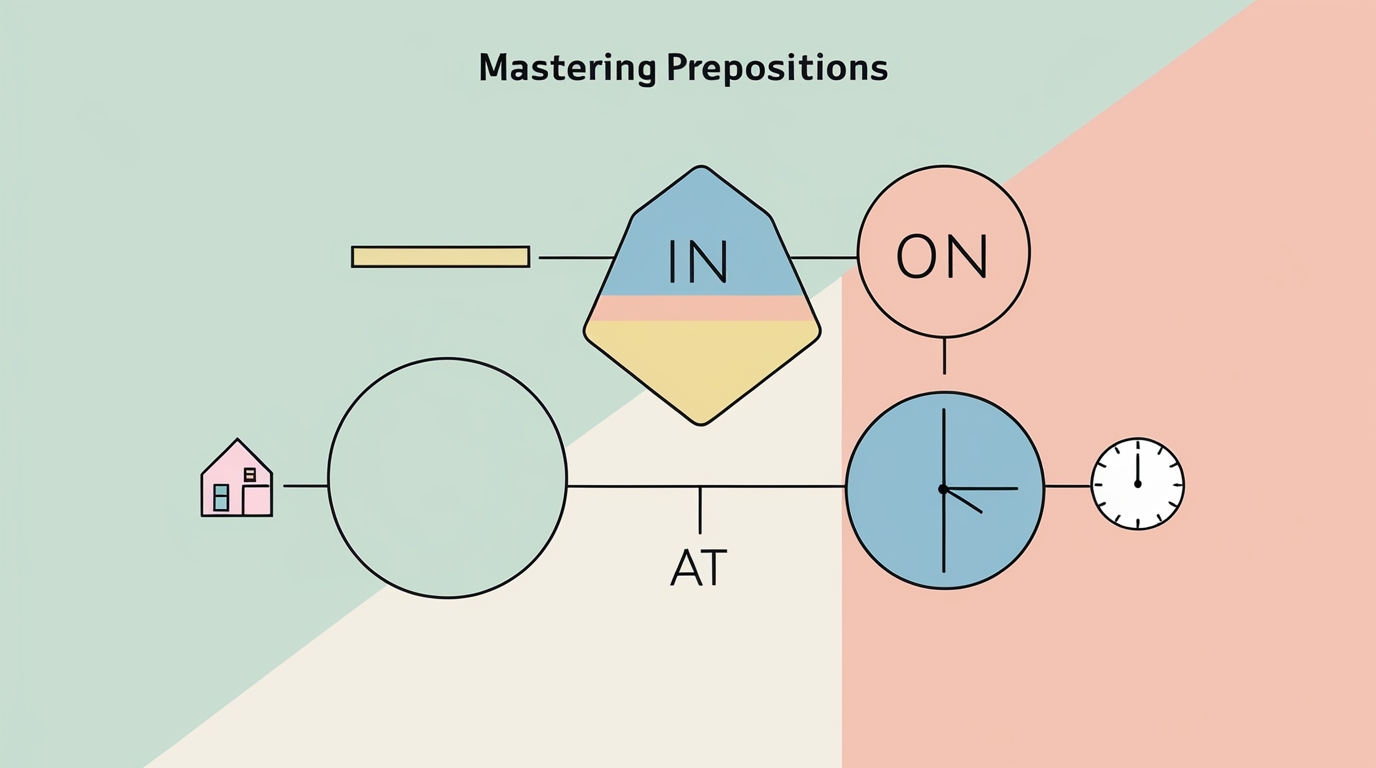
The prepositions “in,” “at,” and “on” are frequently used to indicate both location and time. This dual function makes them essential for expressing where someone or something is and when an event occurred. However, it’s important to note that these prepositions are not interchangeable, so knowing when to use each one is crucial to clear communication.
In, on & at as prepositions of place
To clarify complex information, we’ve arranged it into easy-to-read tables. The first table details the usage of “in,” “on,” and “at” as prepositions of place. You’ll also find practical examples of these prepositions, showcasing their common usage in everyday conversations.
|
Preposition |
Situations |
Examples |
|
at |
At a very specific point, location, or place |
|
|
on |
On a surface Exceptions: general street names and close to a river |
|
|
in |
In an enclosed space or a general area that contains borders or boundaries |
|
|
When discussing buildings or enclosed spaces, the choice between the prepositions “at” and “in” hinges on the context. Use “at” to indicate a general location, as in “Mary is at the school.” Conversely, if you want to highlight that someone or something is physically inside, opt for “in,” such as “Mary is in the school.” Understanding this distinction helps convey your message more clearly. |
||
In, on & at as prepositions of time
The second table highlights the same prepositions—specifically in, on, and at—used to describe particular hours, days, or times of day. It includes clear examples to enhance your understanding of how to use these prepositions effectively.
|
Preposition |
Situations |
Examples |
|
at |
|
|
|
on |
Specific days and dates
|
|
|
in |
More general times
Exception for times of day: morning, afternoon, evening |
|
|
*Note: In American English, we use the preposition “on” when referring to weekends and holidays, as illustrated above. In contrast, British English and some other dialects often employ “at” for the same occasions. Discover more about these differences below. |
||
Preposition switching in American and British English
One key distinction between American and British grammar lies in the usage of the prepositions “in,” “on,” and “at.” To help you navigate these variations with confidence, we’ve provided some examples below, ensuring you can master whichever form of English you choose to learn.
On and at
American English: Will you visit on the weekend?
British English: Will you visit at the weekend?
In and for
American English: I haven’t visited in years!
British English: I haven’t visited for years!
In and at
American English: I study law in school
British English: I study law at school
Understanding these differences will enhance your ability to communicate like a native speaker, whether in Britain or the US. Fortunately, since many Brits are exposed to American media, they will likely understand you even if you mix up terms.
Common mistakes with prepositions in, on, or at
Navigating the nuances of prepositions like “in,” “on,” and “at” can be tricky, especially with the numerous subtle rules involved. To help you master their usage, we’ve compiled a list of common mistakes learners often make, along with the correct applications of each preposition.
Mixing up time and place usage:
Incorrect: “I will meet you in 5 PM.”
Correct: “I will meet you at 5 PM.”
Using “in” instead of “on” for days and dates:
Incorrect: “Our meeting is in October 5th.”
Correct: “Our meeting is on October 5th.”
Using “in” or “on” instead of “at” for specific addresses or locations:
Incorrect: “He lives in 123 Main Street.”
Correct: “He lives at 123 Main Street.”
With some idiomatic expressions:
Incorrect: “He’s on a hurry.”
Correct: “He’s in a hurry.”
Using “at” with pages (including web pages):
Incorrect: “The answer is at page 12.”
Correct: “The answer is on page 12.”
Understanding the Difference: “In the End” vs. “At the End” in Time and Outcome Contexts
Incorrect: “In the end of the movie, they get married.”
Correct: “At the end of the movie, they get married.”
Incorrect: “At the end, I was just tired of arguing.”
Correct: “In the end, I was just tired of arguing.”
When you don’t have to use the in, on, and at prepositions at all
Before general time expressions:
Incorrect: “She works on every weekend.”
Correct: “She works every weekend.”
Before specific verbs or phrases that don’t require prepositions:
Incorrect: “I entered in the room.”
Correct: “I entered the room.”
Before “next” or “last”:
Incorrect: “We met on last Friday.”
Correct: “We met last Friday.”
Final thoughts on the in, on, and at prepositions
Feeling uncertain despite our best tips? No need to worry! LingualNeeds English tutors are ready to support you. With customized learning plans, flexible scheduling, and a host of additional benefits, discovering the ideal tutor has never been easier. Say goodbye to doubt and hello to confident English skills!
Frequently Asked Questions
What are the main prepositions of time and place in English?
The main prepositions of time and place are ‘in,’ ‘on,’ and ‘at.’
When should I use ‘at’ as a preposition?
‘At’ is used for very specific points, locations, or times.
How is ‘on’ used differently from ‘in’ and ‘at’?
‘On’ is used to indicate a surface, specific days, and dates.
What are common mistakes learners make with these prepositions?
Common mistakes include mixing up time and place usage, using ‘in’ for days and dates, and using ‘at’ for specific addresses.
How do American and British English differ in the use of these prepositions?
In American English, ‘on’ is used for weekends, while British English often uses ‘at’ for the same context.