
- Frequently Asked Questions
- What is the primary language in Cape Verde?
- How does Brazilian Portuguese differ from European Portuguese?
- What impact do Brazilian novelas have on language learning?
- Are vocabulary differences significant between Brazilian and European Portuguese?
- How do verb conjugations differ when using ‘tu’ and ‘você’?
Portuguese ranks as the fifth most widely spoken language globally, extending far beyond Brazil and Portugal. It is also the primary language in Cape Verde, Guinea-Bissau, Mozambique, and São Tomé and Príncipe. Furthermore, Portuguese holds co-official status in Macau alongside Chinese and in East Timor alongside Tetum, highlighting its diverse cultural reach.
It’s no surprise that countries so far apart exhibit distinct differences in intonation, pronunciation, grammar, and vocabulary. These variations reflect their unique cultural identities and linguistic evolution.
Recently, Brazilian Portuguese has emerged as a unifying force across various countries, largely due to its globally celebrated music and popular soap operas, known as novelas. Similar to how Hollywood films popularized American English, these captivating novelas have significantly contributed to the mainstream appeal of Brazilian Portuguese.
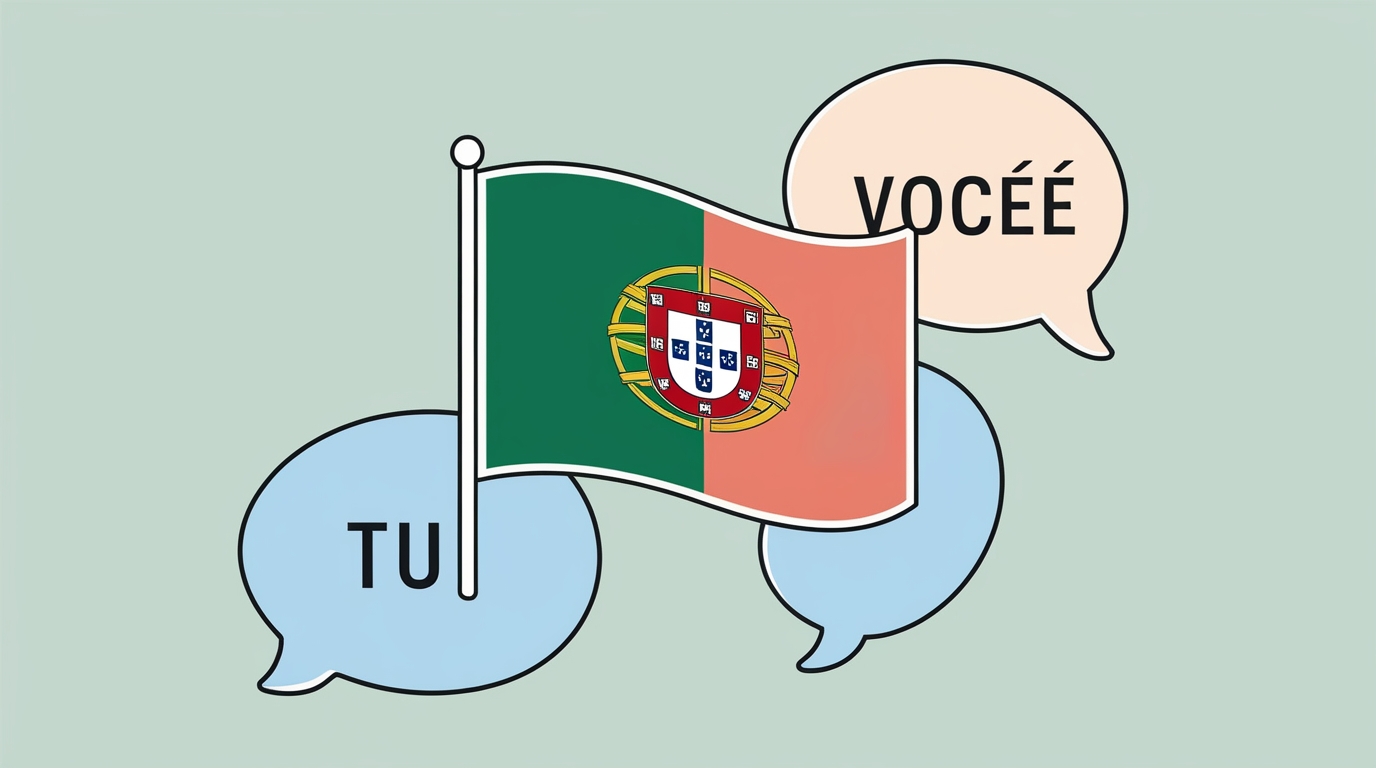
One key distinction between Portuguese as spoken in Brazil and Portugal lies in the use of the pronouns “você” and “tu.” Both translate to the second-person singular “you,” but “tu” is less frequently used in Brazil. In Brazilian Portuguese, “você” predominates in all forms of media and official communications. However, “tu” still appears in certain northern states and is prevalent in the Gaucho dialect of the southern regions.
When using tu the verb is conjugated differently from when você is used.
Look at these examples:
You go to school in the morning.
European Portuguese: Tu vais à escola de manhã.
Brazilian Portuguese: Você vai à escola de manhã.
You are a teacher.
European Portuguese: Tu és professor.
Brazilian Portuguese: Você é professor.
In every Portuguese-speaking country, you’ll find that using “você” is universally understood. For learners, this is particularly advantageous, as conjugating verbs with “você” is straightforward—it matches the third-person singular forms for “he” and “she” (ele/ela).
It’s important to note that the Portuguese spoken in Brazil has some unique features. For instance, the Gaucho dialect, primarily used in Rio Grande do Sul, as well as parts of Paraná and Santa Catarina, employs the term “tu” with verb conjugations that align with “você.”
Tu vai à escola.
Tu é professor.
Although this is limited to conversational, and informal situations, it is common.
In the Living Language Forum, I shared some intriguing examples of vocabulary differences between European and Brazilian Portuguese. Interestingly, many other Portuguese-speaking countries tend to align more closely with the European variant. Here are additional examples to illustrate these distinctions:
identity card
Brazilian Portuguese: cédula de identidade / European Portuguese: bilhete de identidade
driver’s license
Brazilian Portuguese: carteira de motorista / European Portuguese: carta de condução
bathroom
Brazilian Portuguese: banheiro / European Portuguese: sala de banhos
Here are some examples of slight variations in spelling:
watercolor
Brazilian Portuguese: aquarela / European Portuguese: aguarela
truck
Brazilian Portuguese: caminhão / European Portuguese: camião
Frequently Asked Questions
What is the primary language in Cape Verde?
The primary language in Cape Verde is Portuguese.
How does Brazilian Portuguese differ from European Portuguese?
One key difference is the use of pronouns, where ‘você’ is commonly used in Brazil, while ‘tu’ is more prevalent in Portugal.
What impact do Brazilian novelas have on language learning?
Brazilian novelas have contributed to the mainstream appeal of Brazilian Portuguese, making it a unifying force across various countries.
Are vocabulary differences significant between Brazilian and European Portuguese?
Yes, there are notable vocabulary differences, such as ‘cédula de identidade’ in Brazilian Portuguese versus ‘bilhete de identidade’ in European Portuguese.
How do verb conjugations differ when using ‘tu’ and ‘você’?
When using ‘tu,’ the verb is conjugated differently than when using ‘você,’ which matches the third-person singular forms.


