

- The days of the week in Portuguese
- Monday: “Segunda-feira”
- Tuesday: “Terça-feira”
- Wednesday: “Quarta-feira”
- Thursday: “Quinta-feira”
- Friday: “Sexta-feira”
- Saturday: “Sábado”
- Sunday: “Domingo”
- A recap of the vocabulary so far – and a handy pronunciation guide
- Typical weekend plans
- Portuguese dialogue
- English translation
- Key vocabulary
- More Portuguese vocabulary related to time and date
- More useful phrases connected to time and the days of the week
- Final thoughts
- Frequently Asked Questions
- What does ‘segunda-feira’ mean in Portuguese?
- How are the days of the week named in Portuguese?
- What is a common expression to wish someone a good middle of the week in Portuguese?
- What is the significance of the term ‘fim de semana’?
- How do you say ‘see you on Wednesday’ in Portuguese?
Happy Monday! Or is it Friday? Whatever day you’re reading this on, you’re about to learn the Portuguese equivalent!
In this guide, we’ll dive into the seven days of the week in Portuguese. You’ll discover the unique naming conventions that characterize these days, engage with a brief dialogue about planning activities, and expand your vocabulary with some practical terms related to the topic.
“Você está pronto?” (Are you ready?) Then, let’s begin at the start of the week.
The days of the week in Portuguese
As you embark on your journey to learn Portuguese, a strong vocabulary foundation is essential. In this section, we’ll dive into the days of the week and discover a variety of related words and phrases to enhance your language skills.
Monday: “Segunda-feira”
Have you ever wondered about the intriguing name for Monday in Portuguese: “segunda-feira”? Translated, it means “second fair.” This curious term raises a question: is there a mysterious first day of the week that’s been kept under wraps? Or does it have a different origin? Let’s explore the story behind this unique terminology!
In Portuguese, the names of the weekdays are unique as they begin with ordinal numbers (second, third, fourth, etc.). This fascinating practice has its roots in the seventh century when a Portuguese bishop sought to eliminate references to pagan gods in the names of the days. Instead, he created a new system, reflecting a commitment to religious values.
In his approach, Sunday was treated as the first day of the week. (So much for the weekend!)
What about the term “feira”? In Portuguese, the names of the weekdays are closely linked to fairs and markets that historically occurred during the week. This connection highlights the cultural significance of these gatherings in daily life.
Tuesday: “Terça-feira”
If you consider Tuesday to be the second day of the week, it’s time to rethink that perspective! In Portuguese, Tuesday is known as “terça-feira,” which translates to “third fair.” This reflects a different cultural approach to the week’s structure.
Pro tip: In Portuguese, the days of the week are written in lowercase. So, leave those capital letters behind – they’re unnecessary in this case!
Wednesday: “Quarta-feira”
Welcome to “quarta-feira,” the fourth day of the week! While many refer to it as hump day, there isn’t a direct Portuguese translation for that concept. Instead, you can brighten someone’s day by wishing them a cheerful “bom meio de semana,” which translates to “good middle of the week.”
You might just want to say hello in Portuguese, though.
Thursday: “Quinta-feira”
Thursday, known in Portuguese as “quinta-feira” (meaning “fifth fair”), often sneaks up on us. If you’re feeling “muito ocupado” or “muito ocupada” (very busy), it might be a good idea to reassess your time management strategies at the start of the week.
But the good news is there’s only one more day until the “fim de semana” (weekend)!
Friday: “Sexta-feira”
“Happy Friday, everyone! The week is almost behind us, and it’s the perfect moment to wish your colleagues a wonderful weekend ahead!”
Are you considering a fun night out with friends this evening? Perhaps you have a cozy dinner date lined up with your significant other?
Either way, enjoy your Friday evening. You’ve been working hard!
Saturday: “Sábado”
At last, the long-awaited day has come to unwind, enjoy yourself, or hit the town for a night of fun—whatever brings you joy!
Sunday: “Domingo”
Ah, Sunday—the ultimate day for relaxation! Leave behind the stresses of work and study, and indulge in a leisurely stroll through the stunning Algarve or savor a delightful coffee in vibrant Lisbon. Embrace the day; after all, the world is your oyster!
Sundays are the perfect day to unwind, connect with family and friends, and recharge your energy before the week begins. It’s a time to relax and enjoy meaningful moments, setting the tone for a productive start to school or work.
A recap of the vocabulary so far – and a handy pronunciation guide
Here’s a comprehensive summary of the vocabulary we’ve covered so far, along with a handy pronunciation guide for all the new words and phrases you’ve acquired.
| Portuguese | English translation | Pronunciation |
| Bom meio de semana | Good middle of the week | bohm MEH-yoo jee SEH-mah-nah |
| Muito ocupado | Very busy (masculine) | MOO-ee-too oh-coo-PAH-doo |
| Muito ocupada | Very busy (feminine) | MOO-ee-too oh-coo-PAH-dah |
| Começo da semana | Beginning of the week | coh-MEH-soh dah SEH-mah-nah |
| Fim de semana | Weekend | feem jee seh-MAH-nah |
| Feliz sexta! | Happy Friday! | feh-LEEZ SEHS-tah |
| Semana | Week | seh-MAH-nah |
| Bom fim de semana | Have a good weekend | bohm feem jee seh-MAH-nah |
| Sair com seus amigos | Go out with your friends | sa-EER cohm say-oos ah-MEE-gohs |
| Companheiro | Significant other (male) | koh-pah-NYAY-roh |
| Companheira | Significant other (female) | koh-pah-NYAY-rah |
| Um dia para relaxar | A day to relax | oom DEE-ah PAH-rah heh-LAH-shar |
| Sair para festas | Go out and party | sa-EER PAH-rah FES-tahs |
| Te faça feliz | Makes you happy | chee FAH-sah FEH-lees |
If you find this information useful, check out our vocabulary feature available on mobile devices through the App Store and Google Play. Additionally, be sure to read our article on learning Portuguese, which is packed with valuable tips to help you immerse yourself in the language and boost your skills rapidly!
Typical weekend plans
Like many of you, I can’t help but feel excited for the weekend! It’s that special time when I can finally dive into all the enjoyable activities I’ve been dreaming about while at work.
Join us as we explore a conversation between two friends eager to catch a movie together. Unfortunately, their weekend plans fall through, prompting them to rethink their schedule and find a new way to connect.
Explore a variety of expressions tied to the weekdays and planning! After you read the dialogue, challenge yourself to interpret the meaning of each sentence. Once you’re done, you can verify your guesses by checking the translations provided below.
Portuguese dialogue
João: Olá! Tudo certo? Que tal irmos ao cinema neste fim de semana?
Maria: Oi! Estou bem, obrigada. Adoraria! Que tal sábado à tarde?
João: Infelizmente, não posso sábado. Que tal na terça à noite?
Maria: Também não dá para mim. Que tal quarta-feira?
João: Quarta-feira funciona bem! Que tal às 20 horas?
Maria: Perfeito! Vamos assistir ao novo filme de ação?
João: Com certeza! Nos vemos na quarta-feira!
Maria: Combinado, até lá!
English translation
João: Hi there! How’s it going? Are you up for a movie this weekend?
Maria: Hi! I’m doing well, thanks! I’d love to catch a film. How does Saturday afternoon sound?
João: I’m afraid I can’t make it on Saturday. What about Tuesday night?
Maria: Tuesday doesn’t work for me. How about Wednesday?
João: Wednesday is perfect! Shall we meet at 8:00 PM?
Maria: Sounds great! Should we check out the new action movie?
João: Absolutely! Looking forward to it—see you Wednesday!
Maria: Can’t wait! See you then!
Key vocabulary
- “Fim de semana” – The weekend
- “Sábado à tarde” – Saturday afternoon
- “Terça-feira à noite” – Tuesday night
- “Quarta-feira é perfeito.” – Wednesday is perfect.
- “Vemo-nos na quarta-feira então.” – See you on Wednesday, then.
- “Até quarta.” – See you on Wednesday.
In the previous entry, you’ll see that the day is abbreviated to “quarta.” This shortened version, along with others like “segunda,” “terça,” “quinta,” and “sexta,” is commonly used in everyday conversations, making them a familiar part of daily life.
More Portuguese vocabulary related to time and date
You’ve already explored the seven days of the week in Portuguese, discovered the concept of “fim de semana,” and familiarized yourself with vocabulary for planning outings with friends. Keep building on this foundation to enhance your language skills!
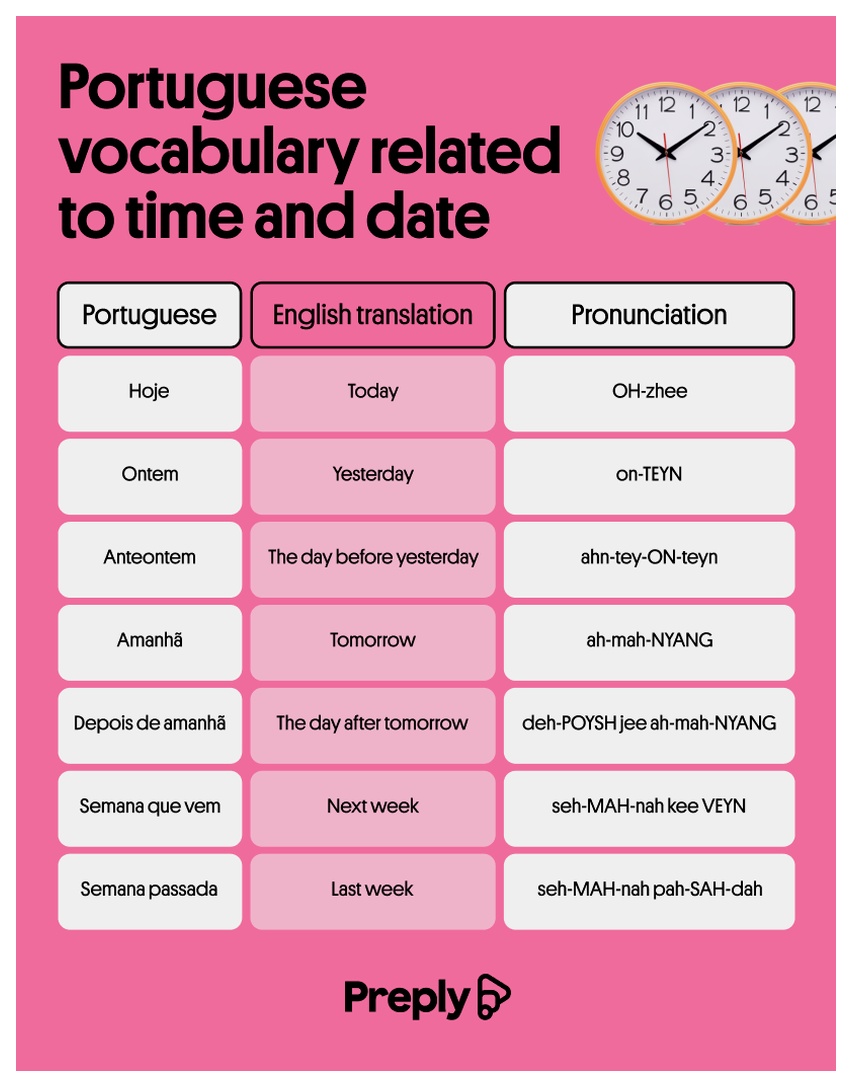
However, there are numerous other expressions that can assist you in navigating the days, weeks, and months ahead in Portuguese.
| Portuguese | English translation | Pronunciation |
| Hoje | Today | OH-zhee |
| Ontem | Yesterday | on-TEYN |
| Anteontem | The day before yesterday | ahn-tey-ON-teyn |
| Amanhã | Tomorrow | ah-mah-NYANG |
| Depois de amanhã | The day after tomorrow | deh-POYSH jee ah-mah-NYANG |
| Semana que vem | Next week | seh-MAH-nah kee VEYN |
| Semana passada | Last week | seh-MAH-nah pah-SAH-dah |
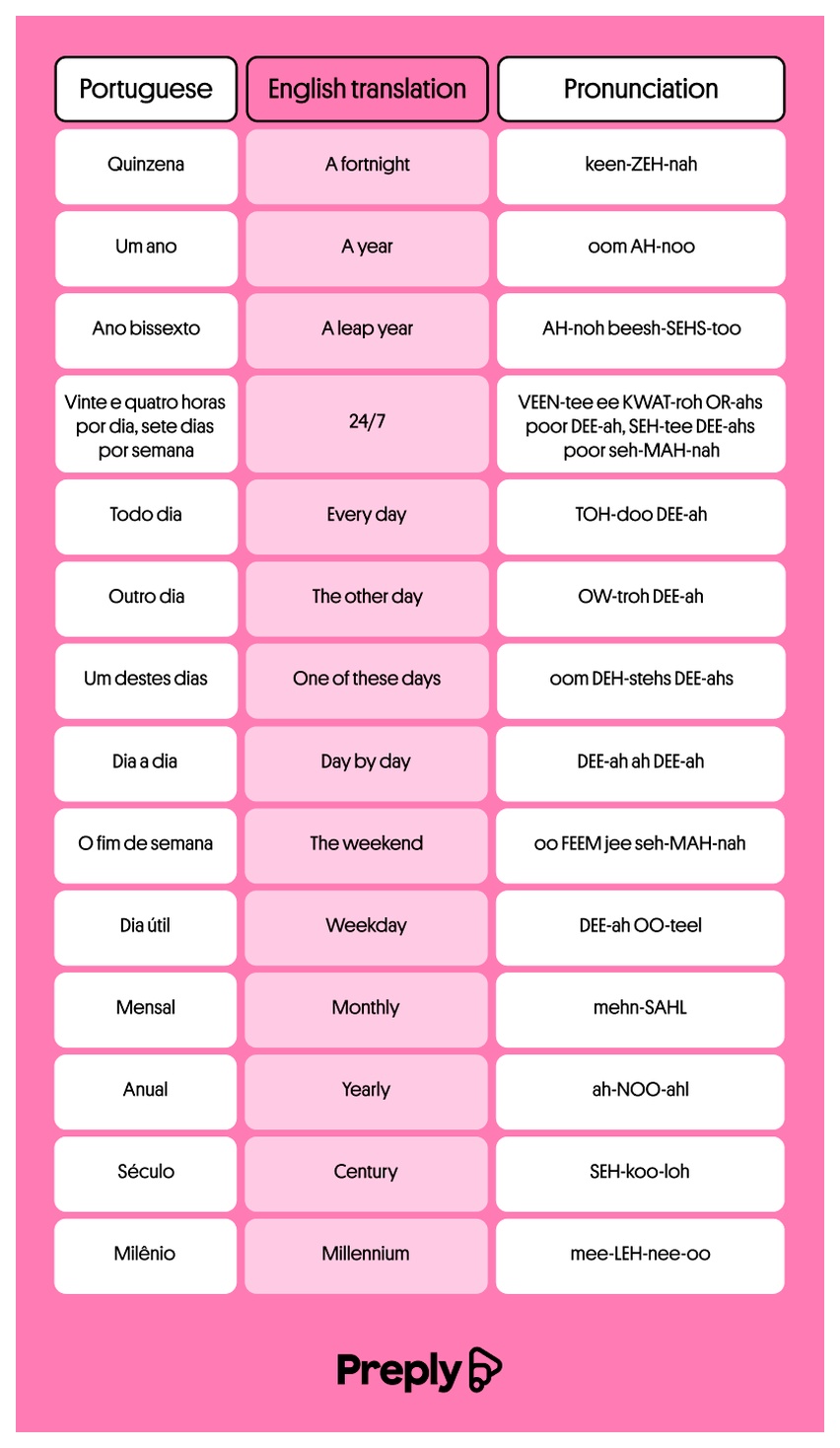
More useful phrases connected to time and the days of the week
If the above words and phrases weren’t enough, the following ones will really enhance your vocabulary:
Final thoughts
Having delved into the days of the week in Portuguese and expanded your vocabulary, you’re now equipped to make plans, assess your weekly availability, and connect with new friends—all while practicing your language skills!
So, why not continue the journey and sign up for some more interactive Portuguese practice?
At LingualNeeds, we bridge the gap between learners and tutors from around the globe. Rely on our innovative technology to discover the perfect Portuguese tutor tailored to your needs.
With LingualNeeds’s engaging conversational Portuguese lessons, you’ll be speaking like a local in no time, guided by an experienced tutor who knows the ins and outs of the language.
Frequently Asked Questions
What does ‘segunda-feira’ mean in Portuguese?
‘Segunda-feira’ translates to ‘second fair’ in English.
How are the days of the week named in Portuguese?
The days of the week in Portuguese are named using ordinal numbers, reflecting their order in the week.
What is a common expression to wish someone a good middle of the week in Portuguese?
A common expression is ‘bom meio de semana’, which means ‘good middle of the week’.
What is the significance of the term ‘fim de semana’?
‘Fim de semana’ translates to ‘weekend’ in Portuguese, marking the end of the week.
How do you say ‘see you on Wednesday’ in Portuguese?
You say ‘Até quarta’ to mean ‘see you on Wednesday’.


