

- The basics of German sentence structure
- Must-know tips about German word order
- Simple declarative sentences
- German sentence order with indirect objects
- German sentences with negation
- Complex verbs in German sentence structure
- Separable verbs
- Verbs with auxiliaries
- Verbs with adverbs
- Conjunctions and German word order
- How to structure questions in German
- Learning German word order with the news
- Mastering German word order: Taking the next steps
- Frequently Asked Questions
- What are the four grammatical cases in German?
- How does German word order differ from English?
- What is the typical structure of a simple declarative sentence in German?
- How do you form a question in German?
- What strategies can help improve understanding of German sentence structure?
The German word order can be a real puzzle for learners. At times, it mirrors English, making it easier to grasp, but other instances can feel quite foreign. In fact, some even liken it to Yoda’s unique speech pattern!
At first glance, the word order in German sentences might appear confusing. However, there’s no need for concern—we’re here to help! German syntax follows specific patterns that make sense once you understand them, and we’re excited to guide you through the details.
In this article, we’ll explore the key rules that shape the most common German sentence structures. We’ll analyze a few practical examples to illustrate how these structures function in everyday language.
Lastly, let’s explore some effective strategies to help you master German sentence structure, making it feel as natural to you as your native language—so you can communicate effortlessly instead of sounding out of place.
Keep reading to learn more or discover online German classes on LingualNeeds.

The basics of German sentence structure
German features four distinct grammatical cases: nominative, accusative, dative, and genitive. These cases play a crucial role in identifying who or what is impacted—either directly or indirectly—by the action in a sentence. Understanding these cases enhances your grasp of sentence structure and meaning in the language.
Consequently, German offers a unique flexibility in its word order, allowing you to rearrange words for added emphasis. This feature enables speakers to highlight specific elements of a sentence effectively.
Even so, German word order matters.
Engaging with German conversation partners shows your dedication to learning their language, which they’ll certainly value. However, if you aim to communicate naturally, paying attention to word order is crucial. Incorrect arrangements can not only hinder your fluency but may also lead to misunderstandings in conversations.
Before diving into the various types of German sentences, let’s take a moment for a brief grammar refresher. This will be especially helpful if you haven’t tackled sentence diagramming since your school days!
- The subject is the word performing the action in a sentence, typically a personal pronoun such as ich (I), du (you – singular informal), er (he), or wir (we). In German grammar, the subject is always in the nominative case.
- The verb, of course, is the “action word” — even if it’s something more passive, like sein (to be) or mögen (to like).
- The direct object is the person, animal, or thing receiving the action of a verb, commonly found in the Accusative case. Examples include items that are heard, liked, written, or eaten.
- The indirect object is who- or whatever is the recipient of the direct object. It takes the Dative case in German.
Must-know tips about German word order
The structure of German sentences varies significantly based on their type. Let’s explore some common sentence forms and the specific word orders associated with each.
We’ll keep it simple, mostly using beginner-level words and phrases.
Simple declarative sentences
These are the fundamental sentence structures, following a word order similar to English: Subject–Verb–Object. This arrangement forms the backbone of clear communication.
| Subject | Verb | Object | Translation |
| Wir | hören | sie. | We hear her. |
| Er | mag | Katen. | He likes cats. |
| Ich | esse | Brot. | I eat bread. |
| Alex | ist | eine Frau. | Alex is a woman. |
| Sie | schreibt | Kinderbücher. | She writes children’s books. |

German sentence order with indirect objects
What happens if we specify who or what is receiving the direct object? That’s where the indirect object comes in.
| Subject | Verb | Indirect Object Pronoun | Direct Object | Translation |
| Er | gibt | ihm | den Kaffee. | He gives him the coffee. |
In this example, the direct object “der Kaffee” (the coffee), which is a common noun in the accusative case, appears at the end of the sentence. Meanwhile, the indirect object “ihm” (him) is positioned before the direct object, immediately following the verb.
Even if we substituted the indirect object’s proper name, Ulrich, for ihm (him), the word order would stay the same:
| Subject | Verb | Indirect Object | Direct Object (common noun) | Translation |
| Er | gibt | Ulrich | den Kaffee. | He gives Ulrich the coffee. |
But let’s say we want to replace der Kaffee with ihn (it [accusative case, masculine]). That will change the word order:
| Subject | Verb | Direct Object Pronoun | Indirect Object | Translation |
| Er | gibt | ihn | Ulrich. | He gives it to Ulrich. |
| Er | gibt | ihn | ihm. | He gives it to him. |
In this example, we replace “der Kaffee” with a pronoun, “ihn,” which represents the direct object. It’s important to note that the direct object always comes before the indirect object, regardless of whether we use the name “Ulrich” or the pronoun “ihm” (him) to refer to the indirect object.
In both cases, this is fairly simple, because English has the same structure.
German sentences with negation
In German, you can negate a sentence in two primary ways: using “nicht” (not) or “kein” (not any). Both “nicht” and “kein” occupy similar positions in a sentence, but their placement may change based on other words present. Understanding when to use each is key to mastering negation in German.
In the simplest example, a declarative sentence in the negative, you would have Subject – Verb – Negation, perhaps followed by an Object:
| Subject | Verb | Negation | Object(s) | Translation |
| Ich | laufe | nicht. | I do not walk. | |
| Er | macht | kein | Essen. | He doesn’t make any food. |
When enhancing a verb with an adverb or describing a noun with an adjective, place these modifiers after the negation for clarity and impact.
| Subject | Verb | Negation | Adverb/Adjective | Translation |
| Du | rennst | nicht | schnell. | You do not run quickly. |
| Die Jungen | sind | nicht | laut. | The boys are not noisy. |

Complex verbs in German sentence structure
In addition to negation, several factors can influence the word order of German verbs within a sentence.
Separable verbs
In German, certain verbs are classified as “separable.” This means that their prefixes can detach and shift to different parts of the sentence when used. Common prefixes that can separate include ab-, vor-, zu-, auf-, ein-, and zurück, among others. Understanding this feature is key to mastering the structure of German sentences!
Typically, the core of a conjugated verb follows directly after the subject, while the separable prefix is attached at the end of the sentence.
| Subject | Verb | Direct Object | Verb Prefix | Translation |
| Ich | gebe | das Buch | zurück. | I’m giving the book back. |
If you were to add an indirect object, it would then go before the direct object, like so:
| Subject | Verb | Indirect Object | Direct Object | Verb Prefix | Translation |
| Ich | gebe | dir | das Buch | zurück. | I’m giving the book back to you. |
| Ich | gebe | Hans | das Buch | zurück. | I’m giving the book back to Hans. |
If you were to substitute es (it) for das Buch (the book), the sentence would then read:
| Subject | Verb | Direct Object Pronoun | Indirect Object Pronoun | Verb Prefix | Translation |
| Ich | gebe | es | dir | zurück. | I’m giving it back to you. |
In the sentence, while the other elements remain in their original positions, the direct object pronoun is now placed before the indirect object pronoun.
Verbs with auxiliaries
In German, certain sentences combine a main verb with an auxiliary verb to convey meaning. The auxiliary verb is conjugated, while the main verb appears in its infinitive or past participle form.
Consider the English phrases, “I’m going to walk home” and “He had walked home.” Here, the words “going” and “had” serve as auxiliary verbs that help convey the action. The main action in both sentences is expressed by the verb “to walk.”
In German sentence structure, the conjugated auxiliary verb typically occupies the second position, while the infinitive or past participle is placed at the end. This arrangement is essential for constructing clear and grammatically correct sentences.
| Subject | Auxiliary Verb | Direct Object | Past Participle / Infinitive | Translation |
| Sie | haben | einen Apfelkuchen | gebacken. | They have baked an apple cake. |
| Ich | werde | ihren Apfelkuchen | essen. | I will eat their apple cake. |

Verbs with adverbs
If you qualify the verb with an adverb, the adverb will go directly after the verb, before the object:
| Subject | Verb | Adverb | Direct Object | Translation |
| Ich | esse | wieder | Gemüse. | I’m eating vegetables again. |
Conjunctions and German word order
Depending on which conjunction you use to introduce a clause, the word order can change.
When employing a coordinating conjunction, stick to the standard Subject–Verb–Object structure in each part of your sentence. Common coordinating conjunctions to watch for include:
- aber (but)
- und (and)
- denn (because)
- sondern (rather)
- oder (or)
- doch (however, but)
| Subject | Verb | Object | Coordinating Conjunction | Subject | Verb | Object | Translation |
| Ich | mag | Katzen, | aber | meine Mutter | mag | Hunde. | I like cats, but my mother likes dogs. |
| Paula | pflanzt | Blumen | und | sie | beschneidet | Bäume. | Paula plants flowers and she prunes trees. |
However, if you start a sentence with a subordinating conjunction, the word order changes. Some common subordinating conjunctions in German:
- solange (as long as)
- sobald (as soon as)
- da (because)
- bis (until)
- wann (when [used with questions])
- ehe (before)
- während (during, while)
- wenn (when, if)
- dass (that)
| Subordinating Conjunction | Subject | Object | Verb | Verb | Subject | Object | Translation |
| Wenn | sie | kommt, | tanze | ich. | When she comes, I dance. | ||
| Da | ich | dich | mag, | necke | ich | dich. | Because I like you, I tease you. |
| Sobald | ich | Schokolade | bekomme, | esse | ich | sie. | As soon as I get chocolate, I eat it. |
How to structure questions in German
The word order of a German question depends on what type of question it is.
For a simple yes-or-no question, place the verb first:
| Verb | Subject | Object | Translation |
| Hast | du | Geschwister? | Do you have siblings? |
| Mag | sie | Kekse? | Does she like cookies? |
When forming a question that begins with words like “warum” (why), “was” (what), or “wie” (how), place the question word at the beginning. Additionally, make sure to position any objects before the verb for clarity.
| Question Word | Object(s) | Verb | Subject | Translation |
| Was | singen | wir? | What are we singing? | |
| Wie viel | Brüder | haben | Sie? | How many brothers do you have? |
| Welche | Sprachen | spricht | er? | Which languages does he speak? |
Discover the art of crafting questions in German by exploring our comprehensive article, “How to Ask German Questions,” which includes over 70 practical examples. Dive in to enhance your language skills!
Learning German word order with the news
One way to study German sentence structure with real-life examples is to analyze sentences from news articles.
Nachtrichten Leicht, which translates to “News Light,” is a German newspaper tailored specifically for language learners. It features clear and straightforward writing, making it easier for readers to grasp news stories compared to traditional German newspapers. Additionally, the website includes a German-only Wörterbuch (dictionary) to further assist learners in expanding their vocabulary.
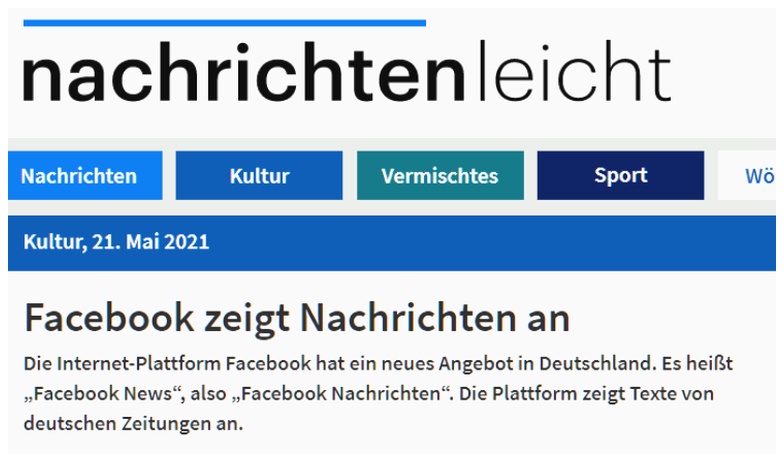
Let’s dive into the highlights of a recent article titled “Facebook zeigt Nachrichten an” and analyze its sentence structure.
| Subject | Verb | Direct Object | Indirect Object | Translation |
| Die Internet-Plattform Facebook | hat | ein neues Angebot | in Deutschland. | The internet platform, Facebook, has something new to offer in Germany. |
| Subject | Verb | Direct Object | Conjunction | Direct Object | Translation |
| Es | heißt | „Facebook News“, | also | „Facebook Nachrichten“. | It’s called “Facebook News,” thus, “Facebook Nachrichten.” |
| Subject | Verb | Direct Object | Indirect Object | Verb Prefix | Translation |
| Die Plattform | zeigt | Texte | von deutschen Zeitungen | an. | The platform displays texts from German newspapers. |
The more time you invest in exercises like these, the faster and deeper your grasp of German syntax will become!
Mastering German word order: Taking the next steps
We’ve explored the intricacies of word order in various types of German sentences. Now, let’s dive into a more enjoyable and creative approach! Here’s how you can immerse yourself in a wealth of German sentences:
- Tune In: Regularly listen to German podcasts, radio shows, and music. Additionally, stream German-language videos, TV shows, and movies to enhance your language skills.
- Read widely: Read in German as often as you can, from many different sources like magazines, news articles, and books.
- **Learn German Through Engaging Stories**: Stories effectively teach German sentence structure by incorporating questions, narratives, and dialogue. Their entertaining nature keeps you emotionally engaged, enhancing your ability to absorb and retain information.
- Build your own sentences: When you’re ready to practice building German sentences of your own, try interactive exercises to coach you along.
- Connect with fluent German speakers: Receive feedback and explore diverse German sentence structures through language exchange partners or community interactions.
- **Hire a German Tutor**: For mastering the complexities of German word order, consider a one-on-one tutor from LingualNeeds. Enjoy personalized sessions that fit your schedule and address your specific questions about German sentence structure, making online learning both effective and convenient.
Mastering German sentence structure can be quite a challenge, but it’s entirely achievable! By immersing yourself in the language through regular reading and listening, along with dedicated speaking and writing practice, you’ll become adept at German word order and improve your ability to communicate effectively. Remember, Übung macht den Meister—practice makes perfect!
Frequently Asked Questions
What are the four grammatical cases in German?
The four grammatical cases in German are nominative, accusative, dative, and genitive.
How does German word order differ from English?
German offers more flexibility in word order, allowing for rearrangement to emphasize specific sentence elements.
What is the typical structure of a simple declarative sentence in German?
The typical structure is Subject–Verb–Object, similar to English.
How do you form a question in German?
For a yes-or-no question, place the verb first; for questions starting with words like ‘was’ or ‘wie’, place the question word at the beginning.
What strategies can help improve understanding of German sentence structure?
Listening to German media, reading widely, practicing sentence building, and connecting with fluent speakers can enhance understanding.


