- Frequently Asked Questions
- What is the present perfect tense used for?
- How is the present perfect tense formed?
- What are some examples of time-marking words used with the present perfect tense?
- When should I avoid using the present perfect tense?
- How can I practice using the present perfect tense in my daily life?

Many English learners often find the present perfect tense intimidating and perplexing, especially if their native language lacks this particular verb form.
There really is nothing in this verb form to be afraid of.
In today’s article, we’ll explore the present perfect tense in English—how to form it and when to use it. By the end, I hope you’ll feel comfortable and confident using this unique verb form!
Let’s start by looking at when we need to use this verb tense.
Using the Present Perfect
The key takeaway is that the present perfect tense describes actions that occurred in the past and were completed prior to the current moment. In simpler terms, it connects past events to the present time when you’re discussing them.
This verb form doesn’t specify the exact timing of the action; instead, it emphasizes the outcome or the fact that the action has been completed.
Often, in order to indicate that this is what we’re talking about, we use time-marking words such as just, already, yet, recently, lately, etc.
For example:
- Jane has already read this book (that is, before the moment we are speaking about it).
- We haven’t seen each other recently.
When discussing an action that has happened repeatedly from the past to the present, using the present perfect tense is the right choice.
- I have visited Rome three times.
- We have eaten at this restaurant many times.
The present perfect tense is not only used for actions completed in the past, but also for those that started in the past and are still ongoing today. For instance:
- They have known each other for 3 years.
- I have studied English since childhood.
We use the present perfect tense when the action is still ongoing and can be linked to time expressions like today, this week, this month, or this year. Check out the following examples:
- Ellie has written 20 articles this month.
- My sister has eaten a lot of ice cream this week.
Another situation where we utilize the present perfect tense is when discussing our experiences up to the current moment. For instance:
- Have you ever been to London?
- He has never been to Japan.
- We have never spent so much time together.
In such cases, such adverbs of time as ever, never, so far, up to now, until now are used.
Remember, when using the present perfect tense, you should avoid specific time indicators like “yesterday,” “5 years ago,” “last summer,” or “at 3 o’clock.” Instead, opt for the past simple tense in these situations.
Forming the Present Perfect
Now let’s take a look at how the present perfect is formed in English.
The structure is fairly simple: have/has + past participle/V-ed.
To construct a proper sentence, you need to use the verb “have” or “has,” which varies based on the subject performing the action. Follow this by adding the past participle of the main verb. For regular verbs, simply append the “-ed” ending. In contrast, for irregular verbs, you’ll need to use their unique third form.
Check out the table of irregular verbs featured in the article “The Past Simple Tense: How to Form It and When to Use It.” It’s essential to memorize these verbs to master their usage effectively.
Below, you’ll see examples of affirmative statements, negative statements, and questions in the present perfect, using the regular verb work.
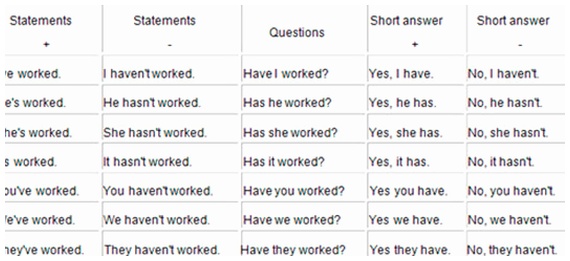
The adverb not is used to form negative statements and comes after the verb have/has.
This can also be shortened into a contraction: have + not = haven’t; has + not = hasn’t. For example:
- I haven’t asked you to come and yell at me.
- It hasn’t stopped raining all day.
In order to ask a general question, move the verb have/has to the beginning of the sentence.
- Have you cleaned the room yet?
- Has she bought that dress?
If you want to ask an informational question, put have/has after the question word, then the subject, and then the verb.
- What has Zoe sent you?
- Why have you done that?
Keep this in mind: When seeking to convey the timing of an action using the word “when,” opt for the past simple tense rather than the present perfect.
- When did you come here?
- When did they meet?
To incorporate the present perfect verb form into your daily routine, try mentally noting the actions you’ve recently completed. For instance, you might think, “I have just read this article,” or “My friend has already shared it in our group.” This simple exercise can help reinforce your understanding and usage of this verb tense.
See you soon!
Frequently Asked Questions
What is the present perfect tense used for?
The present perfect tense describes actions that occurred in the past and were completed prior to the current moment, connecting past events to the present.
How is the present perfect tense formed?
The present perfect tense is formed using ‘have’ or ‘has’ followed by the past participle of the main verb.
What are some examples of time-marking words used with the present perfect tense?
Some examples include just, already, yet, recently, and lately.
When should I avoid using the present perfect tense?
You should avoid using the present perfect tense when specific time indicators like ‘yesterday’ or ‘5 years ago’ are present; instead, use the past simple tense.
How can I practice using the present perfect tense in my daily life?
You can practice by mentally noting actions you’ve recently completed, such as thinking, ‘I have just read this article’.