
- Frequently Asked Questions
- How do you form the present continuous tense?
- When should the present continuous tense be used?
- How do you create a negative sentence in the present continuous?
- What is the structure for asking questions in the present continuous?
- Which verbs should not be used in the present continuous tense?
Today we’ll consider how to form and use the present continuous verb tense in English.
If you have just started to learn English, note the article Guidelines for Using the Present Simple Tense in English.
How to Form the Present Continuous Tense
The present continuous structure is relatively simple.
To construct a proper sentence, you need to use the correct form of the verb “to be,” which varies based on the subject performing the action. Additionally, you should add the “-ing” ending to the main verb. For instance, you would say, “I am writing now.”
The personal pronoun and to be are often shortened into a contraction: I’m, you’re, he’s, she’s, it’s, we’re, they’re:
We’re making a cake now.
The table below shows how to form questions and negative statements using the present continuous verb form.
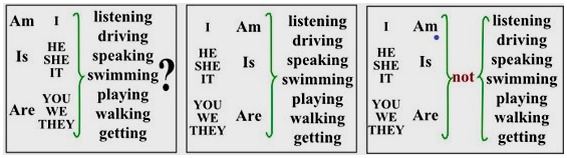
The structure is straightforward! To create a negative sentence, simply place the adverb “not” right after the verb “to be.”
To ask a question, start your sentence with the verb “to be,” unless it’s a specific question that requires a different structure.
When to Use Present Continuous
The present continuous form is used to speak about an event that is happening at the moment of speaking.
Often in a sentence, there are time indicating words such as now, at the moment, right now, etc.
Examples:
- I am listening to music now.
- She is cooking dinner at the moment.
- They are swimming in the pool right now.
- It is snowing outside.
The present continuous tense is utilized to describe ongoing actions that are occurring right now, even if they aren’t happening at the precise moment of speaking.
- She is studying at school.
- My brother is learning to drive.
- I am working on a very important project.
These are the main ways that present continuous is used. But let’s look at some additional ways.
If you want to describe a certain characteristic of a person, especially negatively or critically, use present continuous:
- She is always shouting at me.
- Why are you always making me angry?
The present continuous verb form is not just for actions happening now; it also helps us discuss planned future events, especially when using verbs of motion.
- We are arriving at 6 p.m. in London.
- She is leaving in two hours.
Be careful, as verbs connected to
- perceptions (smell, feel, see, notice…)
- emotions (like, love, hate…)
- mental processes (think, understand, believe…)
- possession (posses, have…)
do not use the present continuous verb form, as the words themselves indicate a process.
- I love cats.
- Do you see me?
I think that you now understand how to form and use the present continuous tense in English.
If you have any questions, write them to me!
Enjoy learning English!
Frequently Asked Questions
How do you form the present continuous tense?
To form the present continuous tense, use the correct form of the verb ‘to be’ based on the subject, and add the ‘-ing’ ending to the main verb.
When should the present continuous tense be used?
The present continuous tense is used to describe actions happening at the moment of speaking or ongoing actions, as well as planned future events.
How do you create a negative sentence in the present continuous?
To create a negative sentence in the present continuous, place the adverb ‘not’ right after the verb ‘to be’.
What is the structure for asking questions in the present continuous?
To ask a question in the present continuous, start your sentence with the verb ‘to be’.
Which verbs should not be used in the present continuous tense?
Verbs related to perceptions, emotions, mental processes, and possession should not be used in the present continuous tense.